How to Read Building Inspection Reports Before Buying a Property

Buying a property can be exciting, but the excitement can fade quickly when a building inspection report lands in your inbox filled with unfamiliar terms, defect classifications and technical observations.
For many buyers, the challenge is not simply obtaining a report. It is understanding what the findings actually mean.
Knowing how to read Building Inspection Reports before buying a property can help you separate minor maintenance issues from defects that may deserve closer attention. It can also help you prepare better questions for the inspector, conveyancer or other relevant professionals before making a major financial commitment.
This article focuses specifically on interpreting inspection findings rather than explaining the inspection process itself, helping Australian property buyers approach a report with greater clarity and confidence.
At a Glance
When reading Building Inspection Reports, focus on:
- The overall condition of the property
- Defects identified as major or significant
- Evidence of moisture, movement or deterioration
- Areas that could not be fully inspected
- Recommendations for further specialist investigation
- Maintenance items that may become expensive later
- Photographs and their connection to written findings
A long defect list does not automatically mean a property is a disaster. Likewise, a short report does not necessarily mean everything is perfect.
The important question is: What do the findings mean collectively for this particular property?
Want to understand the details? Keep reading.
Start With the Summary, But Do Not Stop There
Most buyers naturally head straight to the summary section.
That makes sense. Nobody receives a 30-page technical document and thinks, “Excellent, some relaxing bedtime reading.”
The summary usually highlights the most important findings, especially major defects or areas requiring further investigation.
However, it should be treated as a starting point rather than the entire story.
A report may contain smaller observations throughout the document that are worth understanding when considered together. For example, one isolated moisture stain may seem minor, but several moisture-related findings across different parts of the property may suggest a broader issue requiring investigation.
Pro Tip: Read the summary first, then work through the full report and return to the summary afterwards. The findings often make more sense once you understand the context.
Understand the Difference Between Major and Minor Defects
One of the most useful parts of many Building Inspection Reports is the classification of defects.
Terminology can vary depending on the inspector and relevant reporting framework, but defects are commonly discussed in terms of severity.
Major defects
These may involve significant deterioration, structural concerns or problems that could require substantial repair.
Examples may include:
- Significant cracking
- Structural movement
- Serious water penetration
- Deteriorated structural components
- Major roof or subfloor concerns
A major defect does not automatically mean you should walk away from a property. It does mean you should understand the issue before proceeding.
Minor defects
Minor defects often relate to maintenance, wear and tear or relatively small repairs.
Examples can include:
- Small cracks
- Damaged sealant
- Loose fittings
- Minor surface deterioration
- Localised maintenance issues
Every established home has imperfections. If you are expecting a 25-year-old house to have absolutely no defects, you may need to adjust either your expectations or your property search to include brand-new houses wrapped in bubble wrap.
Pay Attention to Patterns, Not Just Individual Problems
A good way to read an inspection report is to look for connections between findings.
Suppose the report mentions:
- Elevated moisture near a bathroom
- Staining on an adjacent wall
- Deteriorated skirting
- Poor sealant around the shower
Individually, each finding might appear manageable.
Together, however, they may indicate a moisture problem that deserves further investigation.
This is why reading Building Inspection Reports requires more than counting how many defects appear on the page.
The pattern of defects can sometimes matter more than the number of defects.
Look Closely at Areas That Could Not Be Inspected
One of the most overlooked sections of a report is the list of inaccessible or restricted areas.
Inspectors can only report on areas that can reasonably and safely be accessed at the time of inspection.
Access may be limited by:
- Furniture or stored items
- Insufficient roof space clearance
- Locked rooms
- Low subfloor areas
- Floor coverings
- Wall linings
- Landscaping
- Safety concerns
This does not mean a defect exists behind every inaccessible area.
It simply means the inspector could not confirm the condition.
Did You Know?
A limitation can sometimes be just as important as a visible finding because it identifies an area where uncertainty remains.
If an important section of the property could not be inspected, consider asking whether additional access or further investigation is practical before purchasing.
Use the Photographs With the Written Findings
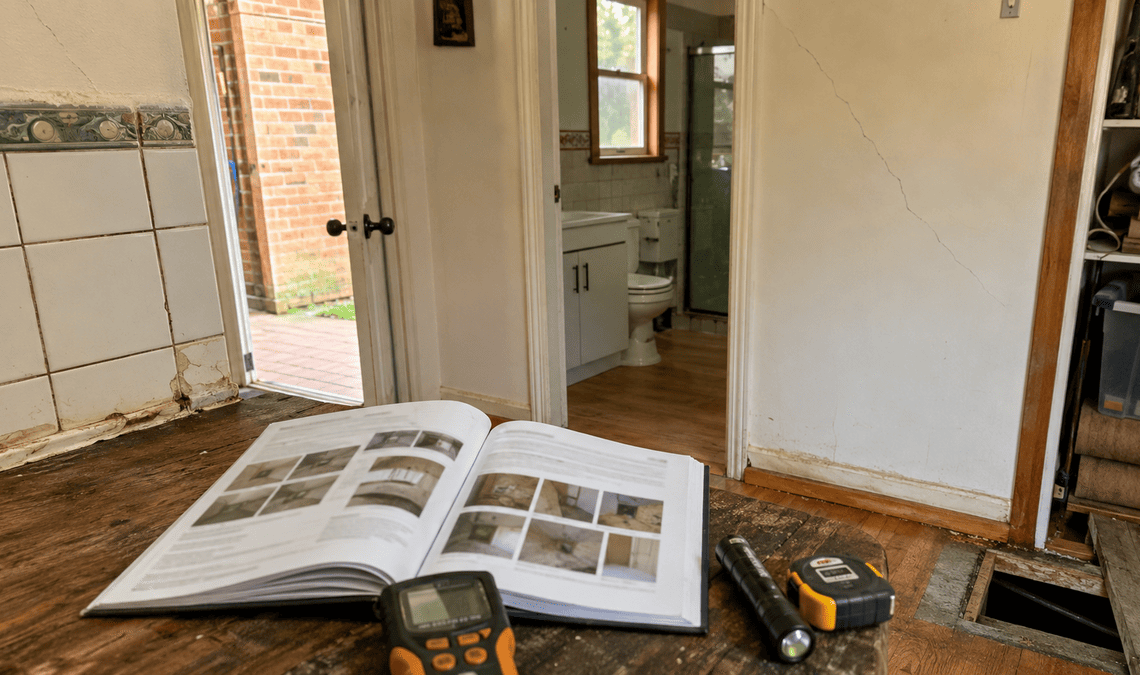
Photographs are particularly useful when reading a building inspection report, but avoid treating them as standalone evidence.
A photo of a crack may look dramatic when enlarged on a computer screen. In reality, it could be relatively minor.
Conversely, an ordinary-looking stain may be associated with a more important moisture finding.
Always read:
Photo + description + location + inspector’s recommendation
together.
That gives you much more context than the image alone.
Quick Guide: When a Report Contains Several Concerning Findings
Imagine you are considering an established home that appears well maintained during the open inspection. The building report then identifies several issues involving cracking, moisture and limited access beneath part of the house.
It can be difficult to know whether these findings are normal maintenance issues or reasons for greater concern.
Common questions buyers may have
- Is that crack cosmetic or potentially structural?
- Could the moisture reading indicate an active leak?
- What might be hidden in the inaccessible area?
How to approach the report
Prioritise the major findings
Start with items the inspector has classified as significant rather than giving every defect equal weight.
Ask for clarification
If terminology is unclear, speak with the inspector. A short explanation can provide useful context that is difficult to capture in a written report.
Investigate recommendations
If the report recommends advice from a structural engineer, plumber, electrician or another specialist, consider obtaining that information before making an unconditional commitment.
Think about cumulative costs
Several individually manageable repairs can still become expensive when combined.
Why this approach works
Rather than reacting emotionally to individual defects, you build a clearer picture of the property’s overall condition, remaining uncertainties and potential future costs.
If a report raises questions you cannot confidently answer, resolving them before purchase is generally easier than discovering the answer after settlement.
Do Not Ignore Recommendations for Further Investigation
Inspectors sometimes identify conditions that fall outside the scope of a standard building inspection.
The report might recommend further advice from specialists such as:
- Structural engineers
- Licensed plumbers
- Electricians
- Roofing contractors
- Waterproofing specialists
- Timber pest inspectors
These recommendations should not automatically be interpreted as confirmation that something is seriously wrong.
They usually mean that the inspector observed something requiring specialist knowledge or testing before a definitive conclusion can be reached.
Think of it as the building equivalent of your GP referring you to a specialist. It does not necessarily mean disaster; it means more information is needed.
Consider the Property’s Age and Construction
Defects should also be interpreted in context.
A house built several decades ago may naturally show more wear, movement and maintenance requirements than a recently completed property.
The construction type matters too.
For example, issues affecting:
- Brick veneer houses
- Weatherboard homes
- Concrete structures
- Older masonry buildings
may present differently.
Comparing an older property with the standards you would expect from a brand-new home can create unrealistic expectations.
The more useful question is whether the property’s condition is reasonable for its age, construction and maintenance history.
Mini Quiz: How Would You Read the Report?
Question 1
The report lists 18 minor defects but no major defects. What should you do?
A. Reject the property immediately
B. Ignore the defects entirely
C. Review the repairs collectively and consider likely maintenance costs
Answer: C.
Minor issues may still have financial implications when there are many of them.
Question 2
The inspector could not access part of the roof space.
Does that mean the area is defective?
No. It means its condition could not be fully assessed.
Question 3
The report recommends a structural engineer inspect significant cracking.
Should you assume the property has structural failure?
Not necessarily. The recommendation means specialist assessment is appropriate before drawing conclusions.
If you answered all three correctly, you are already reading inspection reports more carefully than many buyers.
Questions Worth Asking After Reading the Report
After reviewing the document, consider asking the inspector:
- Which findings deserve the most attention?
- Are any defects likely to worsen if left untreated?
- Are any findings unusual for a property of this age?
- Were important areas inaccessible?
- Which recommendations should be investigated before purchase?
- Are there defects that appear related to one another?
Clear questions usually produce more useful answers than simply asking, “Is this house okay?”
FAQs About Building Inspection Reports
Can a building inspection report tell me whether I should buy the property?
Not usually.
An inspector provides information about the observable condition of the property. The purchasing decision depends on your budget, risk tolerance, repair expectations and advice from other professionals.
Does a long building inspection report mean the property is in poor condition?
Not necessarily.
A detailed inspector may document numerous minor defects. The severity and significance of the findings matter more than the page count.
Should I get repair quotes before buying?
For potentially expensive defects, obtaining estimates can help you understand the financial implications.
If the issue requires specialist assessment first, however, determining the cause may be more important than immediately requesting a repair price.
What if the report contains terminology I do not understand?
Ask the inspector.
Technical language can easily be misinterpreted, particularly around cracking, moisture and structural movement. Clarification can help you understand whether a finding is routine, significant or simply requires further investigation.
Conclusion
Learning how to read Building Inspection Reports is less about understanding every technical term and more about identifying what matters most.
Start with the major findings, look for patterns, pay attention to inaccessible areas and carefully review recommendations for further investigation. Consider defects in the context of the property’s age and construction rather than expecting an established home to be completely flawless.
Most importantly, avoid making decisions based on one photograph or one alarming sentence.
A building inspection report is a due diligence tool. When read carefully and followed up appropriately, it can help you approach a property purchase with a much clearer understanding of what you may be buying.