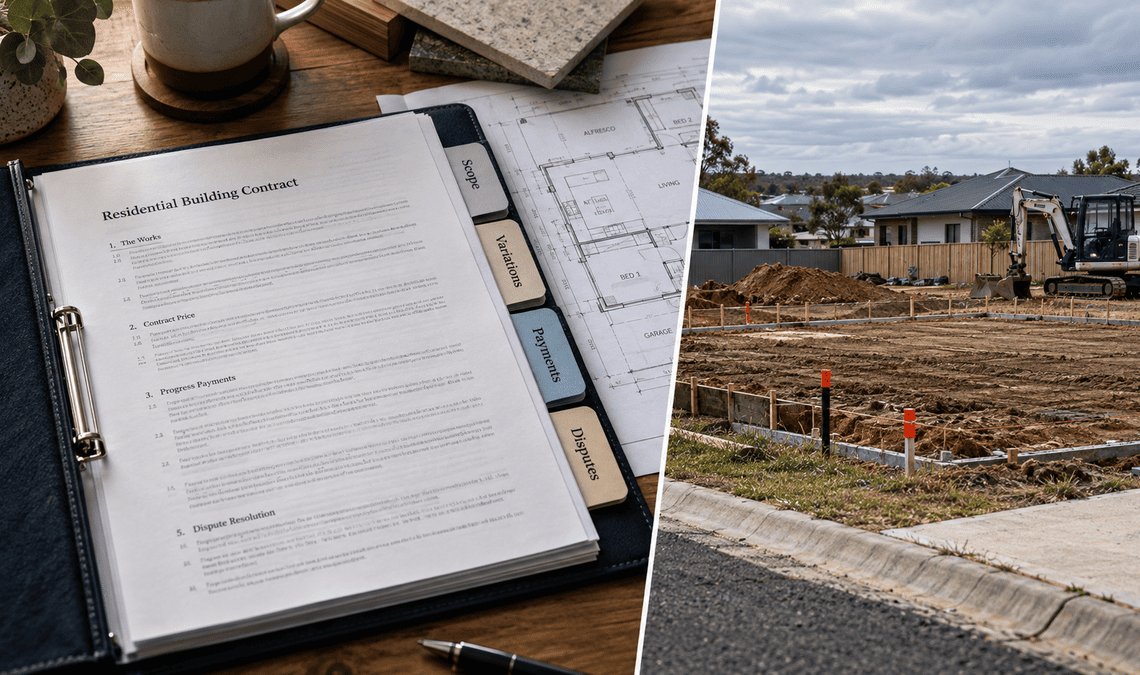
What a Residential Building Contract Should Clearly Describe

Construction / Australian homeowner guide
The contract should describe the home you are paying for — not just the price.
Before building starts, you should be able to point to the agreed drawings, understand what happens when something changes, identify when payments become due and know the process if you disagree with the builder.
This guide explains what a residential building contract should clearly describe, with practical questions you can use when checking your paperwork.
Scope and drawings: make the result identifiable
A description such as “construct a four-bedroom home to standard specifications” leaves too much open. A useful scope of works tells you what is included, what is excluded and which signed or referenced documents settle questions about the work.
Look for a clear description of demolition or site preparation, foundations, framing, roofing, services, waterproofing, finishes, fixtures, landscaping and clean-up where those items form part of your project. For renovations, the contract should also explain how existing structures and retained areas are treated.
Approved drawings and detailed specifications should be identified by revision and date and attached or incorporated in the contract. If a floor plan shows one window while the specification names a different size, the agreement should explain how inconsistencies are resolved, rather than leaving either party to guess.
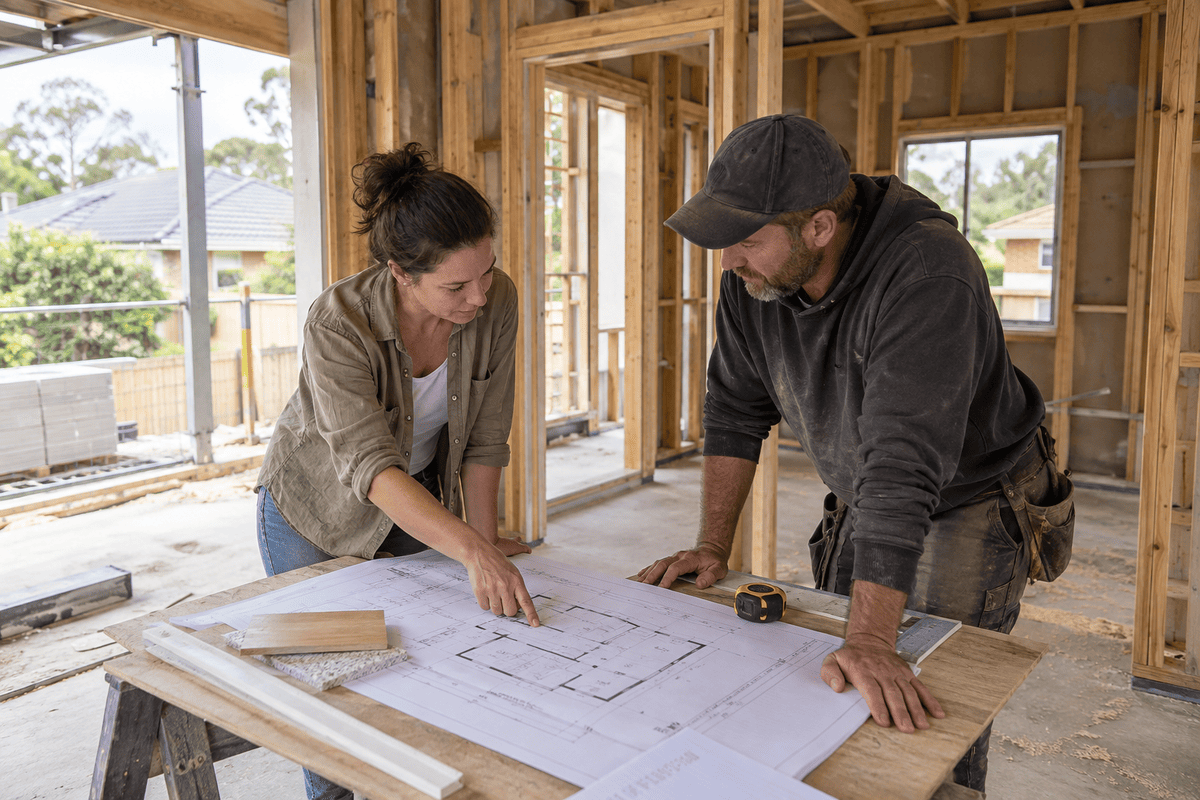
Details worth pinning down before signing
- Materials and finishes: brands, product models, performance requirements, colours or genuinely equivalent alternatives.
- Inclusions and exclusions: fencing, driveway, site drainage, connection fees, temporary services, removal of spoil, appliances and window coverings, as relevant.
- Site assumptions: the information used for soil conditions, access, rock excavation, existing services and other possible cost changes.
- Responsibility for approvals: who arranges and pays for permits, surveys, engineering, inspections and certifications.
Ask this: “If this item is missing, different or finished to a lower standard, which drawing or specification will tell us what was promised?”
This is especially important where the building quote, plans and final contract were prepared at different times. Ensure the final document set is consistent before signing.
Variations and allowances: make changes traceable
A variation changes the original agreed work. An allowance estimates a cost that cannot yet be fixed. Both can alter your final bill, but they are not the same thing — and the contract should treat them separately.
Variations
A change to the scope, design, material, specification or construction method. The process should identify who proposes it, what it costs, whether it affects completion time and how it is approved.
Allowances
Often listed as prime cost (PC) items for particular fixtures and fittings, or provisional sums (PS) for work that cannot be fully priced at contract stage. Check what each estimate includes.
For example, imagine a hypothetical kitchen contract with a $1,500 allowance for a cooktop. If you later select a $2,100 model, the additional cost may not simply be $600: the contract might also permit a builder’s margin or related installation costs. The calculation, allowance basis and approval process should be clear in advance.
Before accepting a change, request a written description, the price adjustment (including relevant margins and GST treatment), any effect on the completion date and an updated document reference. In NSW, variations to covered home building contracts generally must be recorded in writing and signed by both sides, subject to limited exceptions such as urgent safety-related work. NSW Government contract guidance explains this process.

Do not rely on a conversation at the site gate or an informal text that does not identify the approved change. Also check what happens when the builder discovers an unforeseen condition: who confirms the issue, who determines the remedy, and what evidence supports the new price?
Payment stages: link claims to completed work
The contract should state the deposit, each progress payment, the milestone or basis for claiming it, invoice requirements and the point at which the final payment becomes due. It should also explain how variations affect those amounts.
For a typical new home, stages may be described using terms such as base, frame, lock-up, fixing and practical completion. The labels alone are not enough: you need the contract’s definition of when each stage is complete and the legal rules that apply to it.
Ask what supporting records accompany a payment claim: evidence of completed work, relevant inspection or certification records, and documentation for approved variations. Your lender may also require an inspection before releasing staged finance.
One national rule would be misleading. For example, NSW generally caps a residential building contract deposit at 10%, while Victoria sets a maximum of 5% for contracts of $20,000 or more and 10% below that threshold. Victorian stage-payment rules also prescribe specific arrangements in many cases. Check the regulator’s guidance for your location before paying. NSW · Victoria
Why the location of the project matters
State and territory law determines when certain contracts must be written, which prescribed information must appear and what deposit, insurance, cooling-off and payment rules apply. The following are examples of common thresholds, not a substitute for reviewing your project’s legal category or the latest rules.
| State | Written-contract requirement — example | Official guidance |
|---|---|---|
| NSW | Home building work over $5,000; more extensive contract over $20,000. | Building Commission NSW |
| Victoria | Major domestic building contract for most applicable work over $10,000. | Consumer Affairs Victoria |
| Queensland | Written contract for relevant domestic building work over $3,300 (including GST). | QBCC |
The same caution applies to insurance documents, the builder’s registration or licence details, statutory warranties and any cooling-off rights. Check them before paying a deposit or signing, not after work has started.
Dispute pathways: know what to do before there is a problem
Disagreements often begin with ordinary questions: Was the tile upgrade approved? Has the frame stage genuinely been reached? Does a rain delay justify an extension? A useful contract explains how those questions become formal notices, how quickly each side must respond and what happens if the dispute remains unresolved.
Check the specific clauses for notices, delays, defects, extensions of time, suspension, termination and dispute resolution. Make sure you know which email or physical address is designated for formal notices and whether simply messaging the site supervisor is sufficient.
Practical order of response
- Identify the disputed clause, drawing, variation or payment claim.
- Put the concern in writing and preserve emails, dated photographs, site records and invoices.
- Follow the notice, meeting or response steps required by the contract.
- Seek the relevant state regulator’s dispute-resolution pathway or independent professional advice before withholding payment, suspending work or terminating.
The available route depends on the state and the nature of the complaint. For example, the QBCC describes a facilitation process for eligible active domestic building contract disputes in Queensland. In Victoria, the Building and Plumbing Commission’s dispute pathways can assist eligible homeowners and builders.
Termination is especially consequential: it can affect access to the site, outstanding payment claims, replacement builder costs and insurance. Have a qualified Australian building lawyer review the position before acting on a purported right to terminate.
The contract review you can do at the kitchen table
You do not need to become a contract lawyer to identify missing information. Place the contract, drawings, specifications and quote together. Read them as one set, then mark every area where you cannot find an unambiguous answer.
Eight things to be able to point to
- Builder identity, licence or registration
- Dated plans and specifications
- Included and excluded work
- Price, PC items and provisional sums
- Signed variation procedure and time impact
- Deposit and stage-payment triggers
- Start date, delays and completion rules
- Defect, notice and dispute process
If any answer is missing, request an amended draft before signing. Check the relevant regulator’s model contract or consumer guide as a benchmark; these resources are more useful than relying on an assumption that a commonly used contract must be fair or complete.
Questions homeowners commonly ask
Is a builder’s quote enough to be the contract?
A quote may describe price and work, but it might not contain the terms and statutory documents required for a residential building contract. The formal requirements vary with the project and jurisdiction. Ask for the appropriate signed contract and its attachments.
Can the agreed price change after signing?
Sometimes, through properly authorised variations, specified allowances or other lawful contract mechanisms. The contract should spell out the circumstances, calculations and approvals. A “fixed price” label does not remove every possible cost change.
Should I pay a stage claim before an inspection?
Check the contract, your state’s rules, required certification and any lender conditions. You can consider engaging an independent building inspector to assess whether the work claimed has been completed, rather than treating an invoice as proof by itself.
The best pre-signing test is simple: could someone unfamiliar with the conversations explain what is being built, how the price may change, when money is due and how a disagreement will be handled? If not, the paperwork probably needs clarification.
General information for Australian homeowners, not legal advice. State and territory laws, contract value thresholds and project-specific requirements differ. Check current local rules and seek independent legal advice where material sums or special conditions are involved.