How Interest Rate Changes Affect Household Repayments

An interest rate rise can increase the amount a household must repay each month; a cut can reduce it. The size and timing depend on the loan’s own rate, outstanding balance, remaining term and repayment type. A cash rate announcement alone doesn’t tell you what will leave your bank account next month.
To understand how interest rate changes affect household repayments, start with your lender’s notice and the loans you actually hold. Then translate any change into a budget amount you can plan around.
ONE LOAN · TWO INTEREST RATES
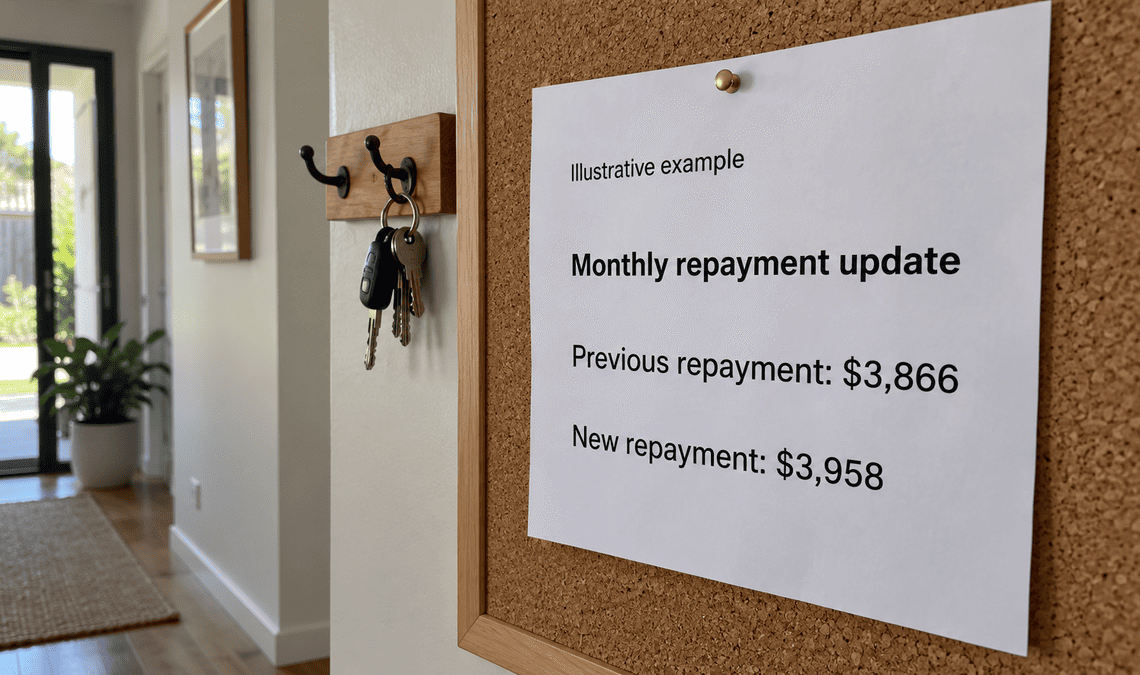
About $92 more each month
Hypothetical $600,000 principal-and-interest loan with 25 years remaining. Rounded estimates, excluding fees and offsets; these are example rates, not current offers or forecasts.
From an RBA decision to your next repayment
The Reserve Bank of Australia sets a target for the cash rate, the rate for overnight lending between financial institutions. That influences borrowing and deposit rates across the economy. It doesn’t set the interest rate in your individual mortgage contract.
As the RBA’s explanation of monetary policy transmission makes clear, market conditions, competition and loan risk also affect lending rates. A lender’s change therefore needn’t match the cash rate movement exactly.
For a household, three separate events matter: the announcement, the date the lender changes the loan’s interest rate, and the date a new required repayment begins. These may not be the same day. Interest costs can change before the next scheduled payment changes.
Look for both effective dates in your lender’s communication. Also check whether an existing direct debit will adjust automatically. A transfer you scheduled yourself may need attention. Confirm the new required payment before changing any payment instruction.
What a rate change looks like in dollars
A move from 6.00% to 6.25% is an increase of 0.25 percentage points, or 25 basis points. It doesn’t mean the monthly repayment rises by 25%, or even by exactly 0.25%. A principal-and-interest payment covers both the interest charge and repayment of the balance over the remaining term.
The table holds the remaining term at 25 years and changes only the loan balance and annual interest rate. This makes the effect easier to see without mixing in a refinance, a term extension or extra borrowing.
| Annual interest rate | $400,000 owing | $600,000 owing | $800,000 owing |
|---|---|---|---|
| 5.75% | $2,516 | $3,775 | $5,033 |
| 6.00% | $2,577 | $3,866 | $5,154 |
| 6.25% | $2,639 | $3,958 | $5,277 |
| 6.50% | $2,701 | $4,051 | $5,402 |
| 7.00% | $2,827 | $4,241 | $5,654 |
Calculations assume 300 equal monthly payments, a constant rate for each scenario, no fees, no offset balance and no extra repayments. Amounts are rounded to the nearest dollar. Real lenders may calculate interest daily and apply different payment conventions.
On the $600,000 example, an increase from 6.00% to 6.50% adds about $185 a month. A move to 7.00% adds about $375. Several small rises can therefore create a sizeable recurring expense, even if the first change seems manageable.
A cut works in the other direction. Reducing the example rate from 6.00% to 5.75% lowers the calculated payment by about $91 a month. Don’t assume that saving is available to spend until you know what your lender will require and what your payment arrangement will actually do.
How were these estimates calculated?
The standard monthly amortisation formula is:
Payment = P × r ÷ [1 − (1 + r)−n]
Here, P is the outstanding balance, r is the annual rate divided by 12 and expressed as a decimal, and n is the number of months remaining. For the opening example, P = 600,000 and n = 300. Each scenario recalculates the payment from that same starting balance.
You can enter your own balance, term and rate into the Moneysmart mortgage calculator. Use the loan rate for the repayment estimate; a comparison rate includes certain costs and serves a different comparison purpose.
Your loan type determines when the change reaches you
Variable-rate loans: watch the lender’s notice
The interest rate can change during the loan. If it rises, the required principal-and-interest repayment may increase to keep the loan on track. If it falls, the minimum may reduce. Check how your lender handles changes and whether you’re already paying above the minimum.
Fixed-rate loans: look ahead to the expiry date
A fixed interest rate generally stays unchanged for the agreed fixed period. That can shelter the fixed portion from rate rises, but it also means a market cut doesn’t automatically reduce that rate. The important budget date may be the end of the fixed period, when different pricing applies.
Split loans: calculate the two portions separately
A split loan combines fixed and variable portions. A variable-rate increase affects that portion while the fixed rate remains in place. Add the two required payments together when estimating the household total. Moneysmart’s fixed and variable loan guide explains these structures and the restrictions to check.
Interest-only loans: distinguish a rate rise from a repayment reset
During an interest-only period, scheduled payments don’t reduce the principal. As a simplified estimate, a 0.25 percentage point rise on a $600,000 interest-only balance adds $1,500 a year in interest, or about $125 a month. Actual monthly amounts depend on the lender’s daily calculation and the number of days charged.
When the interest-only period ends, payments can increase even if the interest rate doesn’t change: you begin repaying the principal over the remaining term. If a rate rise happens at the same time, both changes affect the budget. Check the reset date and use Moneysmart’s interest-only loan guidance to assess the transition.
Why the same rate rise affects households differently
The outstanding balance matters more than the original purchase price. A borrower owing $250,000 and one owing $750,000 won’t face the same dollar increase, even if their rates move identically. Remaining terms matter too: different repayment schedules produce different results.
Another distinction is the minimum repayment versus the amount already being paid. If a household voluntarily pays $4,100 and its required payment rises from $3,866 to $3,958, it may already be transferring enough. But less of the payment will go towards reducing the balance than otherwise would have. The cash leaving the transaction account can stay unchanged while progress slows.
An offset account adds another layer. With a fully linked 100% offset, a $40,000 balance against a $600,000 loan can reduce the balance charged interest to $560,000. That doesn’t necessarily mean the required repayment is recalculated using $560,000. It can instead mean more of an unchanged payment reduces principal.
Check that the offset is linked, whether it provides a full or partial offset, and whether its fees or loan pricing justify the feature. Redraw is different: it relates to extra repayments made into the loan, with access governed by its terms. See Moneysmart’s offset account explanation before treating the two as interchangeable.
Look beyond the mortgage payment
A household repayment budget may also include a car loan, personal loan and credit card. Read each product’s terms rather than assuming all its rates will follow an RBA announcement. A fixed-rate car loan, for example, has a different exposure from a variable mortgage. Credit card pricing and minimum-payment rules are also separate from a mortgage repayment calculation.
Make one list of balances, rates, required payments and due dates. Include a promotional or fixed period’s expiry date where relevant. This shows whether several commitments are due to change together, which can be more useful than knowing the mortgage increase in isolation.
Savings income also belongs in the calculation. Higher deposit rates may benefit savers; lower rates may reduce the income available for bills. The RBA describes these opposing borrower and saver effects in its cash-flow explanation. A household with both savings and debt needs to look at the net change, not just one account.
Turn a new repayment into a workable household budget
Use your lender’s confirmed figure first, then run additional scenarios. A calculator estimate helps you prepare; the lender’s payment notice tells you the required amount and timing for your loan.

- Write down the starting position. Record the balance, remaining term, interest rate and required payment for every loan portion. Use a statement or the lender’s account details, rather than the amount you originally borrowed.
- Separate the confirmed change from a stress test. Budget for the notice you’ve received. Then test what another 0.50 or 1.00 percentage point increase would do, without treating either as a prediction.
- Match the figures to payday. A $185 monthly increase is about $85 per fortnight when annualised: $185 × 12 ÷ 26. Dividing a monthly amount by two would overstate the fortnightly amount because a year has 26 fortnights.
- Include irregular essentials. Set aside amounts for insurance renewals, registration and other foreseeable bills. A budget that balances only in a month without those expenses can give false reassurance.
- Check the payment method. Confirm whether the direct debit changes automatically, and ensure the payment account will have enough funds on the relevant date.
If the budget has room, a trial transfer of the additional amount into an accessible savings account can show how the higher commitment feels. This is a budgeting exercise, not a reason to lock away money needed for essentials or miss an existing payment. Check any access restrictions before directing additional money into a loan.
Compare options without hiding the total cost
Before refinancing, ask the current lender whether a lower rate is available. Compare any offer with alternatives on fees, features and the remaining term. A smaller monthly payment can come partly from stretching the debt over more years, rather than from a genuinely cheaper loan.
Switching can involve discharge, application or fixed-rate break costs, and lenders mortgage insurance may be relevant. Moneysmart’s guide to switching home loans explains why these costs and the new term need to be compared with the saving.
For a simple hypothetical break-even check, $1,200 in switching costs divided by an estimated $100 monthly saving gives 12 months. That is only a first-pass estimate: it assumes the saving continues and excludes changes in balances, rates and fees. Compare the full proposal before making a decision.
If rates fall and you can comfortably retain the old payment, the extra amount may help reduce principal faster, subject to loan conditions. If you need the cash-flow relief instead, confirm the new minimum and payment arrangement. The useful choice depends on your household’s needs, access to emergency money and loan terms.
If the new payment won’t fit, act before it is due
Contact the lender’s hardship team as soon as you expect difficulty. Explain what has changed, what you can afford and whether the problem is temporary or ongoing. Assistance may involve changing a payment arrangement or loan terms; it doesn’t automatically erase interest or debt.
Ask what the arrangement means for interest, the loan term and later repayments, and obtain the details in writing. Moneysmart’s financial hardship guidance outlines the process. A free financial counsellor can also help you assess a realistic budget and discuss options with the lender, as explained in its mortgage repayment support guide.
Your next step is to check the lender’s notice against your payment calendar. Know the new amount, know the first due date, and decide how the difference will be covered before that payment arrives.
General educational information for Australian readers, checked 29 October 2026. Examples are hypothetical and don’t account for your personal circumstances. Seek advice suited to your situation before changing a loan.